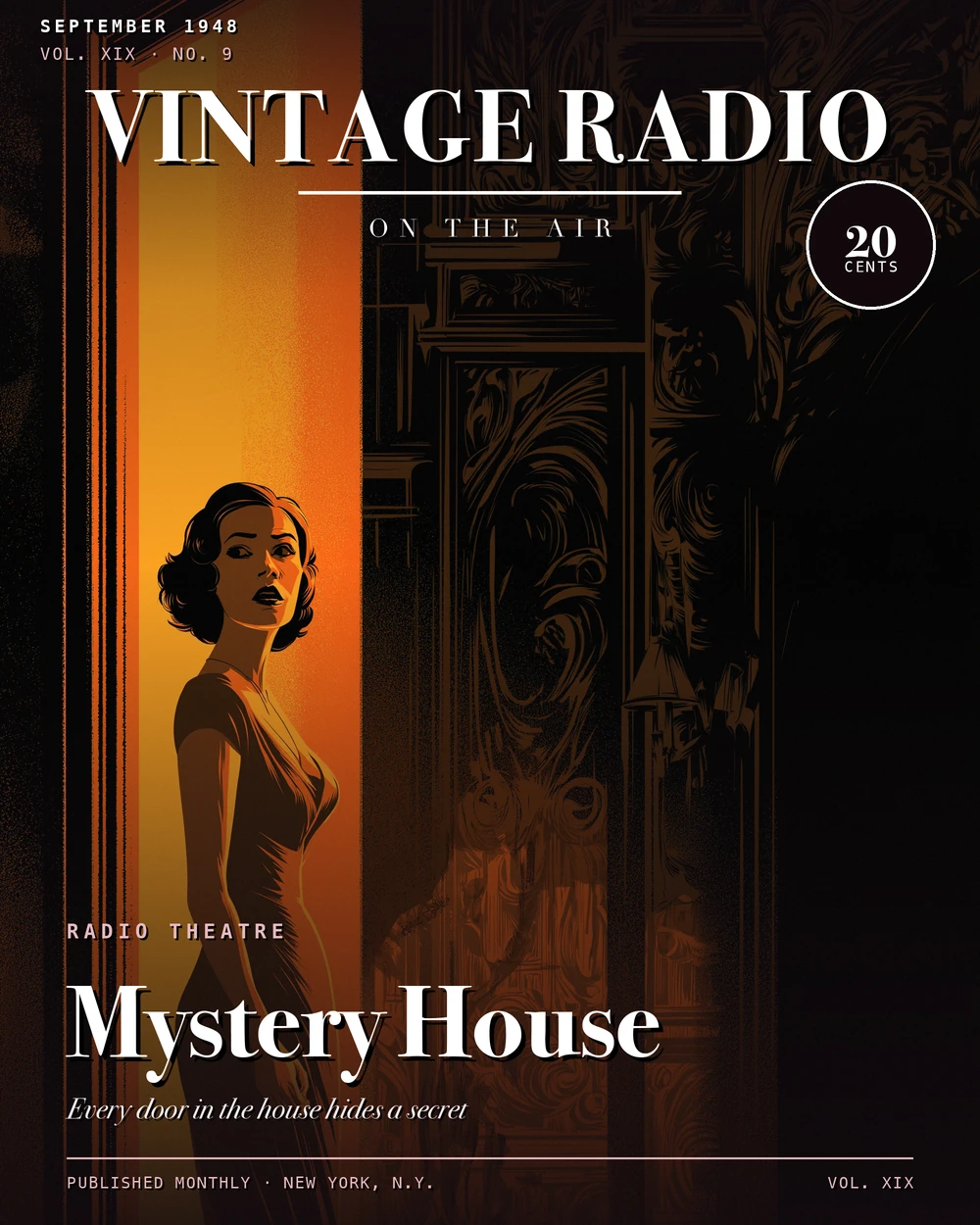
Mystery House
The Publishing Firm That Made a Radio Show
Mystery House had one of the more unusual origins in old-time radio. Dan and Barbara Glenn ran a mystery publishing company called Mystery House, based at 70 Park Avenue in New York City, and somewhere around 1945 they hit on an unconventional idea: instead of relying on editorial judgment alone to decide which manuscripts to publish, they would turn the stories into radio dramas and let the audience reaction help make the call. The radio program that resulted bore the same name as their firm and ran as a syndicated series from August 19, 1945, through March 31, 1946.
The concept was genuinely odd by any radio standard. Each week's episode was a dramatized adaptation of a manuscript the Glenns were actively considering for publication. The listening audience, in effect, served as an extended editorial board. If a story went over well on the air, that was a point in favor of putting it into print. A practical, even frugal, arrangement — the publishing company got market research, and radio listeners got a mystery serial.
A Staff Production, Start to Finish
What made the show stranger still was who actually put it together. The entire staff of the Mystery House publishing company participated in the productions. Employees rewrote manuscripts into radio scripts, played the acting parts, and handled sound effects. This was not a polished network production staffed by trained radio professionals. It was a small firm's in-house operation, and it sounded like one.
Actors Nanette Sargent and Forrest Lewis played fictionalized versions of the Glenns themselves — Barbara and Dan Glenn appeared as characters within the syndicated series, lending the show a meta quality that was unusual for the time. The stories themselves leaned toward crime in domestic settings, which fit the "house" concept tidily: enclosed spaces, ordinary people, hidden secrets. Episode titles like "A New Lease on Death," "Death at Deadline," "Nothing But the Proof," and "Malice in Wonderland" give a sense of the register — wry, slightly pulpy, comfortable in the whodunit tradition.
The full episode list in the known catalog runs to fifteen titles, including "Death Passed My Window," "Murder for Laughs," "Complete With Quartet," "A Case of Homicide," "A Short Life for Mary," "Danger Man at Bay," "Death House Blues," "Death in the Saddle," and "The Thirsty Death." That variety of titles across a short run suggests the Glenns were working through a genuine backlog of manuscript submissions, not padding a thin premise.
The Lugosi Episode
One entry in the catalog stands apart from the rest. A single episode is noticeably more professionally produced than the others — hired announcers, professional actors, a level of polish that the publishing company staff simply wasn't equipped to deliver. That episode stars Bela Lugosi, and it has long carried a rumor that it was never actually broadcast as part of the regular Mystery House run.
The likeliest explanation is that this episode was a separate project: a pilot recorded around autumn 1944 for a proposed series that would have featured Lugosi in Grand Guignol tales under the Mystery House banner. The episode, titled "The Thirsty Death," co-starred John Carradine and Lureen Tuttle. It was backed by the Mystery House press but never reached the airwaves as a series. It remains the only known recorded episode of that proposed Lugosi vehicle, and it ended up folded into the Mystery House catalog, where it stands out clearly from the staff-produced episodes around it.
The presence of this pilot in the surviving collection is one of the more interesting footnotes to the show's history — a glimpse of what the Glenns may have been aiming for before they settled on the lower-budget, in-house format that defined the actual broadcast run.
What Survived
The series was certified complete on February 16, 2011, meaning the fifteen surviving episodes are believed to represent the complete known run. For a short-lived syndicated series produced by a small publishing company with no network infrastructure behind it, that's a reasonably intact legacy.
The show ran as a syndicated series rather than a network broadcast, which is part of why its footprint is modest. Syndicated programs of this period circulated to individual stations on transcription discs rather than going out live over a national feed, and their reach and documentation varied considerably. Mystery House seems to have had a quiet run — no star names in the regular cast, no major sponsor story, no network drama attached to it.
Mystery House has occasionally been confused with "The House of Mystery," a different series that ran on the Mutual network from 1945 to 1949. That show was aimed at children and featured narrator Roger Elliott debunking supernatural phenomena — a completely different premise and audience. The names are similar enough to create mix-ups in catalog research.
There's also a much earlier radio program called "Mystery House" that surfaced on WGN Chicago as far back as 1929 and appeared in various formats — sometimes a weekly half-hour, sometimes a five-day-a-week quarter-hour — as late as 1951. That series is a distinct program with no apparent connection to the Glenn publishing venture. The 1945–1946 Dan and Barbara Glenn version is the one represented in the episode catalog.
The Short Run and What It Tells Us
Mystery House lasted roughly seven months on the air. Whether the experiment succeeded on its own terms — whether any of the manuscripts it dramatized actually made it to print — isn't something the surviving record makes clear. The Mystery House publishing firm did continue operating after the radio series ended; records indicate it was still in business sometime after 1964, so the Glenns kept at it regardless of how the radio venture played out.
What the show offers, aside from its oddity, is a snapshot of how mid-1940s radio could absorb almost any premise if someone was willing to produce it. A mystery anthology series run by a publishing company's staff, using unpublished novels as scripts, is not the kind of project a network executive dreams up — it's the kind of project that happens when people who already have the raw material decide to try something. The fifteen episodes that survive are a record of that experiment, and the Lugosi pilot sitting among them adds an extra layer of strangeness to an already peculiar little show.